
Choosing a China Top Individual Packaged Cotton Swab Supplier requires more than comparing prices. It demands evidence, process knowledge, and careful communication. An Individual-Packaged Cotton Swab may look simple, yet its quality depends on several controlled details. These include cotton purity, stick strength, packaging integrity, sealing consistency, and traceability.
Joseph M. Juran, a respected quality-management expert, said, “Quality does not happen by accident; it must be planned.” His principle applies directly to individually wrapped medical and personal-care swabs. Reliable suppliers should explain their production workflow clearly. They should also provide material specifications, sampling procedures, inspection records, and relevant quality certifications. Buyers should ask whether the product is sterile or non-sterile. That distinction matters.
Small details matter.
A dependable Chinese manufacturer may operate controlled production areas, use medical-grade or cosmetic-grade cotton, and inspect every packaging batch. The wrapper should remain sealed after transport, not split at the corners. The swab tip should stay firmly attached when used gently. These practical checks often reveal more than attractive factory photographs.
However, no supplier should be judged by claims alone. A polished website is not proof. Samples, factory documentation, third-party testing, and transparent responses deserve closer attention. Even experienced buyers can overlook moisture exposure, carton compression, or inconsistent labeling. That is an uncomfortable reality.
This guide examines how to evaluate an Individual-Packaged Cotton Swab supplier in China. It considers manufacturing capability, customization, quality control, export experience, communication, and long-term reliability. The strongest supplier may not be the cheapest. It should be the one that can repeatedly deliver clean, secure, clearly documented products.
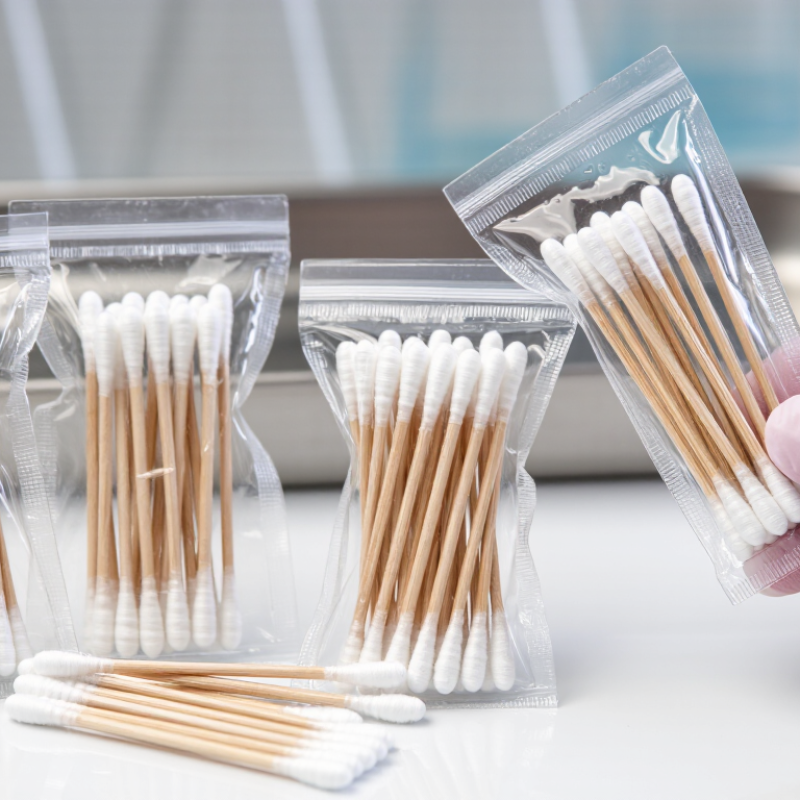
Individually packaged cotton swabs are single cotton-tipped applicators sealed in separate paper or plastic pouches. Each pouch protects the swab from dust, moisture, and contact before use. The package is opened only when the applicator is needed. Simple, but useful.
The cotton tip is usually attached to a paper or plastic stem. Its surface should feel even, firm, and free from loose fibers. A reliable supplier should explain the cotton source, stem material, packaging process, and quality inspections. Batch records matter because appearance alone cannot confirm cleanliness. For products labeled sterile, suppliers should provide appropriate testing and processing evidence. A sealed pouch is not automatically sterile.
In practical use, individually packaged swabs fit first-aid kits, clinics, travel bags, salons, and sampling work. They save space and reduce unnecessary handling. A good pouch should tear smoothly without crushing the stem. It should also show clear information, such as size, lot number, production date, and storage guidance.
Small details matter here. I have found that overly soft tips may shed fibers, while very tight packaging can make opening awkward. Neither issue always appears in a product photograph. Samples, packaging trials, and written specifications give buyers a more honest view. Suppliers should also discuss moisture resistance and carton protection during transportation. Perfection is unlikely, so transparent communication about limitations is a stronger sign of professionalism.
Individually wrapped cotton swabs begin with controlled material selection in a Chinese production facility. Manufacturers usually inspect cotton fibers for cleanliness, softness, and consistent absorbency. The sticks may use paper or plastic, depending on the product design and market requirements. Production teams also check dimensions, tip shape, and attachment strength before assembly.
The cotton is formed around each end by automated or semi-automated equipment. Operators monitor tension, moisture, and machine alignment during this stage. Poor alignment can create loose tips or uneven shapes. That detail matters. After forming, each swab enters an individual wrapping machine. The machine folds packaging film or paper around the swab, seals the edges, and prints batch information when required. Seals receive visual checks and periodic strength testing.
Manufacturers normally inspect samples from every production batch. Checks may include appearance, seal integrity, cleanliness, and package count. For products intended for specific healthcare uses, additional processing and documentation may apply. Requirements differ across markets, so reliable suppliers maintain clear testing records and traceability. In practice, automated equipment improves consistency, but it does not remove human judgment. A sensor may miss a slightly crushed tip. Experienced workers can notice it quickly. Still, this dependence needs reflection. Strong factories reduce risk through documented procedures, calibrated equipment, trained inspectors, and independent quality reviews. Supplier evaluation should include facility audits, sample approval, and transparent communication about limitations. Surface appearance alone is not enough.
China Top Individual Packaged Cotton Swab Supplier?
What Quality Standards Should Cotton Swab Suppliers Meet?
A reliable supplier must control cotton, sticks, packaging, and records. Raw cotton should be clean, absorbent, low-lint, and free from visible foreign particles. The stick needs consistent length, smooth edges, and firm attachment. Individual packaging must resist moisture and opening damage. Clean is not the same as sterile.
The World Health Organization’s 2022 Global Report on Infection Prevention and Control estimates that healthcare-associated infections affect about 7% of patients in high-income countries and 15% in low- and middle-income countries. This makes contamination control more than a purchasing detail. Suppliers should use validated microbial testing, such as USP <61> and <62>, when products are intended for relevant medical applications. ISO 2859-1 supports structured sampling, while ISO 13485 can demonstrate controlled manufacturing processes. However, certification alone does not prove every batch is perfect. A zero-defect promise deserves careful questioning. Sampling has limits, and suppliers should explain them clearly.
Tips: Ask for batch-specific test reports, not only a general certificate. Check seal integrity, lint release, absorbency, and microbial results. Request traceability from cotton lot to finished carton. Review the factory’s corrective-action records. Small details matter. A supplier that admits occasional process variation may be more credible than one offering unrealistic certainty. Some buyers also overlook storage conditions after shipment, which can weaken otherwise sound packaging controls.
| Quality Dimension | Recommended Supplier Requirement | Relevant Standard or Reference | Verification Evidence | Applicability |
|---|---|---|---|---|
| Quality management system | Documented procedures for purchasing, production, inspection, nonconformity control, corrective action, and record retention. | ISO 9001; ISO 13485 when the product is manufactured as a medical device. | Current certificate, scope confirmation, internal-audit records, and corrective-action records. | All suppliers; ISO 13485 is particularly relevant for medical-device applications. |
| Cotton material identity and purity | Use a defined cotton grade with documented fiber composition, cleanliness, color, odor, and absence of visible foreign matter. The buyer should specify whether bleached, absorbent, or untreated cotton is required. | Applicable pharmacopeial or purchaser specifications; no single universal cotton-swab purity limit applies to every market. | Raw-material certificate, incoming inspection, fiber-composition records, and visual inspection results. | All applications. |
| Swab construction and dimensional consistency | Controlled shaft length and diameter, head size, cotton winding, tip shape, and attachment strength. Dimensions must be defined on the approved product drawing. | Approved technical drawing and purchaser acceptance specification. | Calibrated measuring equipment, first-article inspection, in-process checks, and batch inspection reports. | All applications. |
| Tip retention and mechanical integrity | The cotton head should remain securely attached during intended use and should not shed excessive fibers or expose sharp shaft edges. | Validated internal test method based on the intended use and risk assessment. | Pull, twist, bending, fiber-shedding, and visual-inspection test records with defined acceptance criteria. | All applications; tighter controls are needed for clinical use. |
| Absorbency and liquid-transfer performance | Absorbency, wet strength, and liquid-release performance should match the intended use, such as specimen collection, cleaning, or cosmetic application. | Purchaser-defined performance specification; test method must be validated for the product. | Absorption-time, liquid-retention, release, and wet-strength test reports. | Application-dependent. |
| Bioburden control | Manufacturing areas, handling practices, and packaging operations should control microbial contamination. Limits must be justified by product risk and the sterilization process. | ISO 11737-1 for enumeration of microorganisms on products. | Environmental-monitoring records, bioburden test results, trend analysis, and cleaning records. | Required for sterile products; recommended for products used on sensitive areas. |
| Sterilization validation | If labeled sterile, the supplier must use a validated terminal sterilization process and demonstrate that the packaging and product tolerate the process. | ISO 11135 for ethylene oxide, ISO 11137 for radiation, or ISO 17665 for moist heat, as applicable. A sterility assurance level of 10-6 is commonly specified for terminally sterilized medical devices. | Sterilization validation, routine-cycle records, dosimetry or biological-indicator records, and release authorization. | Sterile products only. |
| Biological safety | Materials, processing aids, inks, adhesives, and residual sterilants should be assessed for the intended contact type and duration. | ISO 10993-1 for biological evaluation; applicable chemical, cytotoxicity, irritation, or sensitization tests should be selected according to risk. | Material declarations, risk assessment, chemical-residue testing, and relevant biological-evaluation reports. | Medical and body-contact applications. |
| Packaging integrity | Each individual package should protect the swab from contamination, moisture, damage, and opening before use. Seal strength and package integrity must remain acceptable through distribution. | ISO 11607-1 and ISO 11607-2 for packaging of terminally sterilized medical devices, where applicable. | Seal-strength, dye-penetration or leak, visual-seal, aging, and transport-simulation test results. | Essential for sterile individual packaging; recommended for hygienic products. |
| Sampling and lot acceptance | Use a documented sampling plan with defined critical, major, and minor defect classifications. Sampling should not replace process control. | ISO 2859-1 for attribute-based sampling using acceptance quality limits. | Inspection plan, lot size, sample size, acceptance numbers, defect photographs, and release records. | All applications. |
| Traceability | Each production lot should be traceable to raw materials, operators, equipment, inspection results, packaging materials, sterilization status, and shipment records. | Supplier quality agreement and applicable quality-management requirements. | Lot code, batch record, certificate of conformity, retention samples, and complaint-investigation records. | All applications; critical for regulated products. |
| Labeling and regulatory documentation | Labels should accurately state product description, quantity, lot or batch code, manufacturing information, expiry or shelf-life information where required, and sterile status when applicable. | Destination-market medical-device, consumer-product, chemical, and packaging requirements. | Artwork approval, label inspection, technical file, declaration of conformity where applicable, and shelf-life evidence. | Market-dependent. |
| Shelf life and storage | Shelf life should be supported by real-time or accelerated aging data, with storage conditions defined to control heat, humidity, sunlight, and contamination. | ASTM F1980 may be used for accelerated aging of sterile barrier systems when scientifically justified; distribution testing should reflect the intended supply chain. | Aging protocol, package-integrity results, retained-sample inspection, and transport-simulation report. | Products with a declared shelf life, especially sterile products. |
Note: Acceptance limits should be agreed in the product specification and quality agreement because requirements vary according to intended use, sterility claims, contact type, and destination market.
How to Evaluate China’s Top Individual Packaged Cotton Swab Suppliers?
A capable supplier should explain its manufacturing process clearly, not only quote a low price. Check whether each cotton swab is sealed separately, with clean edges and consistent cotton coverage. Ask for samples from different production batches. One attractive sample proves very little.
Review the cotton type, shaft material, absorbency, lint performance, and packaging strength. Press several sealed packs gently and inspect for loose seals, wrinkles, or air leakage. Request batch records, inspection reports, and traceability details. If the product is marketed as sterile, verify the sterilization method, testing scope, and stated shelf life. Certificates should match the actual factory and product, not merely appear in a sales file.
Factory experience matters when orders become complicated. Evaluate monthly capacity, minimum order quantities, custom packaging options, and realistic lead times. A video tour helps, but an independent audit may reveal more. Ask how rejected units are separated and how complaints are investigated. Communication speed is useful, yet accurate answers matter more. Some suppliers respond quickly but avoid technical questions. That is a warning sign. I would also compare pre-shipment inspection results with received goods, because small packaging defects can increase waste. No evaluation is perfect; even detailed checks may miss a process change after approval. Keep written specifications, approve a reference sample, and review quality again before repeat orders.
This procurement scorecard prioritizes the factors buyers commonly verify when assessing individually packaged cotton swab suppliers. Product safety and compliance receive the highest weighting, followed by cotton purity, packaging integrity, sterilization validation, commercial terms, and delivery performance.
Recommended evaluation weighting: verify applicable quality certifications, material specifications, packaging tests, sterilization records, samples, inspection reports, minimum order quantities, and confirmed lead times before making a final supplier decision.
Individually packaged cotton swabs serve healthcare, dental, cosmetic, laboratory, and personal-care industries. Clinics use them for skin preparation, wound-area cleaning, and applying small amounts of topical products. However, packaging alone does not prove sterility. The World Health Organization reported that healthcare-associated infections affect about 7 in 100 acute-care patients in high-income countries and 15 in 100 in low- and middle-income countries. This supports careful hygiene controls, but cotton swabs are only one small part of the process.
Dental practices often need clean, single-use tools around patients’ mouths. Cosmetic counters and salons use them for eyeliner correction, nail detailing, and precise product application. Laboratories may select individually sealed swabs for controlled sampling, especially when each sample needs separate handling.
Grand View Research estimated the global cotton swabs market at more than USD 1.8 billion in 2023, with continued growth expected through 2030. The demand reflects convenience, hygiene expectations, and professional workflow needs. Food and beverage facilities may also use specialized swabs for environmental monitoring, but they should follow validated procedures.
Tips: Check the material, packaging integrity, lot code, and stated sterility level. Choose a tear-open pouch that protects the swab during storage. Never reuse one. A practical warning remains: individually packaged does not always mean sterile. That detail is easy to overlook. Teams should match the swab to the task, document handling steps, and review supplier test records instead of relying on appearance alone.